
Dementia is a term used to describe progressive changes to the brain that result in differences in people’s memory, communication, behaviour and problem solving. Speech Pathologists play an important role in supporting people with dementia and their caregivers to manage changes in communication and swallowing as the condition progresses.
As a result of the damage to the brain caused by dementia, people can experience changes in their behaviour. For example, a person may start hoarding objects, wandering, acting more aggressively or become easily agitated. Behaviours can be seen as a method of communication when a person is no longer able to identify or express their needs verbally.
Dementia and the CAUSEd model
Alzheimer’s Australia Vic has developed a systematic, person-centred model for considering changes to people’s behaviour known as ‘CAUSEd’ (O’Toole, 2017). In this model, the team is encouraged to look beyond a person’s diagnosis of dementia and consider other factors that may contribute to changes in behaviour. ‘CAUSEd’ is an acronym which stands for:
- Communication
- Activity
- Unwell/Unmet needs
- Story
- Environment
- Dementia
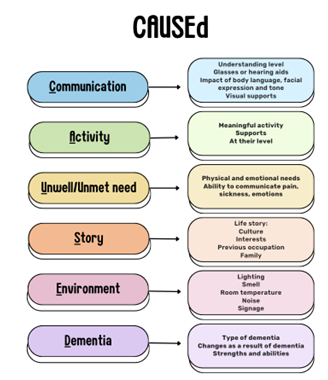
The CAUSEd model supports health care providers to consider the person holistically rather than observing the behaviour as a symptom or result of their dementia alone. This model encourages reflection on what the person may be expressing with the behaviour that they can no longer articulate or communicate in a conventional manner. For example, is the person in pain, can they understand what is expected of them, is an activity meaningful to them? This reflection allows person-centred strategies to be introduced in response to the unmet need that is being communicated by the person’s behaviour rather than to the behaviour itself. Examples of strategies that may be trialed:
- Increasing the lighting in a dark room or adding labels to a cupboard so the person knows what is inside (environment)
- Using a visual schedule so a person knows what to expect within their day or the activity (communication, activity, environment)
- Engaging a person in meaningful activities that draw on their life story (activity, story)
- Reducing background noise or loud music in the house (environment)
- Considering past routines and adapting these to a supporting living facility (story)
The information for this post was derived from Dementia Australia’s free training course ‘Dementia Essentials: CHCAGE011 Provide support to people living with dementia’. Further information and training is available in the course ‘Understanding Changed Behaviour’, which is delivered by Dementia Training Australia.
References
Dementia Australia & Speech Pathology Australia. (2024). Speech Pathology and Dementia Joint Position Statement. https://www.dementia.org.au/sites/default/files/2024-10/Speech-Pathology-joint-position-statement.pdf?slug=sites&slug=default&slug=files&slug=2024-10&slug=Speech-Pathology-joint-position-statement.pdf
Dementia Singapore. (2024). Apply CAUSEd to Understand Behaviour Changes. DementiaHub.SG. https://www.dementiahub.sg/living-well-with-dementia/apply-caused-to-understand-behaviour-changes/
O’Toole, G. (2017) CAUSEd: effective problem solving to support well-being. Australian Journal of Dementia Care, 6(1), p.15-16